State estimation with fdia_analysis.se
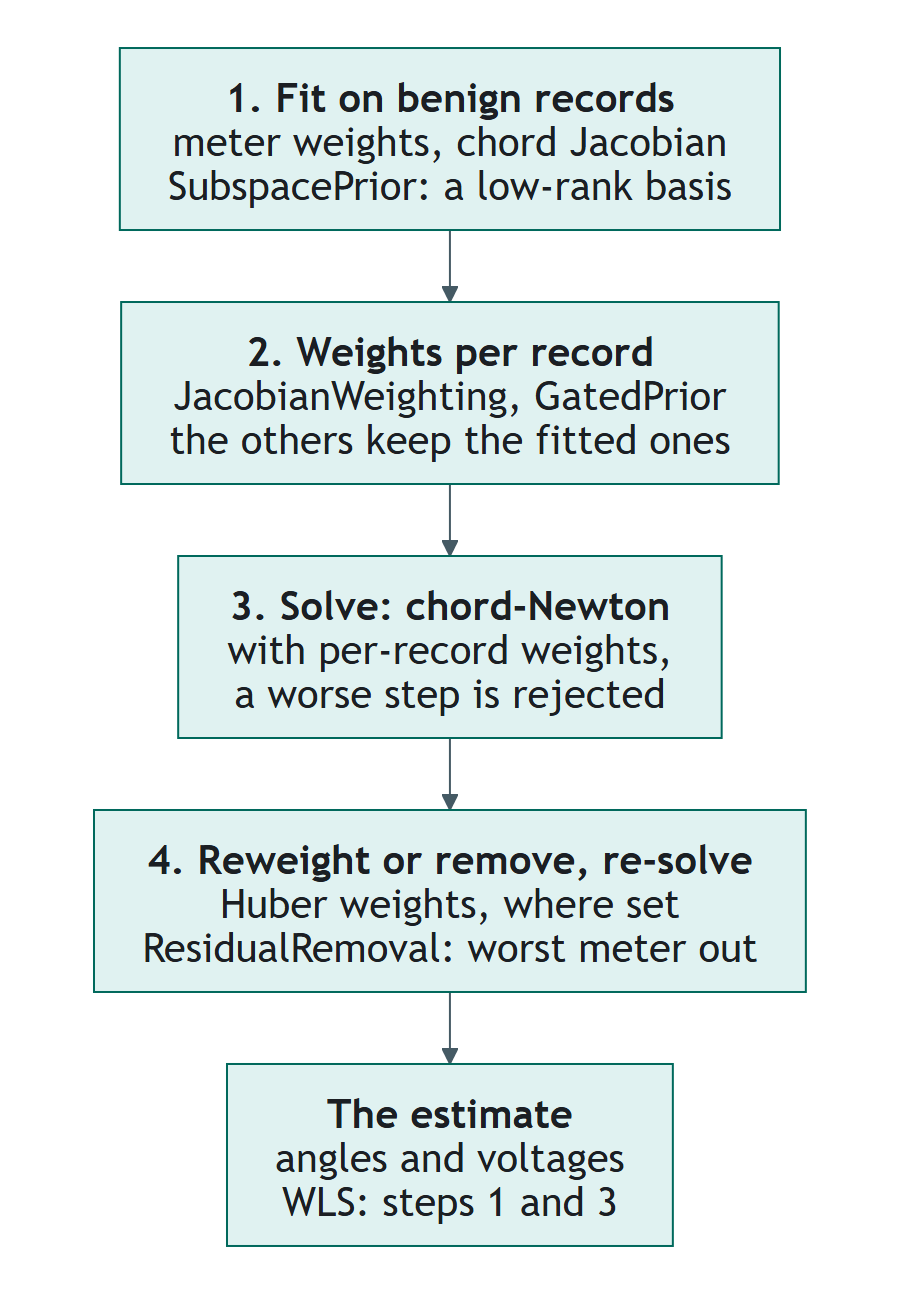
Given a scan of noisy, possibly attacked measurements, estimate the true bus voltages and angles.
Every timeline ships a noiseless clean layer, so the estimate is scored against exact ground truth.
import fdia_graph as fg
from fdia_analysis.models.config import PriorConfig
from fdia_analysis.se.methods import WLS, AdaptiveWeighting, SubspacePrior

train = fg.load("ieee14", split="train")
test = fg.load("ieee14", split="test")

est = SubspacePrior(prior=PriorConfig(rank_frac=0.2, reweight="huber", c=1.5)).fit(train)
xhat = est.estimate(test)  # [n, 2N-1] = [theta rad (non-slack) | V pu (all buses)]
rep = est.score(test)  # per-family angle/voltage MAE vs the clean truth
| needs | pip install "fdia-analysis[se]", a timeline (data release v0.8.3), units="physical" |
|---|---|
| walkthrough | ../../guides/state_estimation.md |
| state | 2N-1: every voltage magnitude, every non-slack angle; slack angle fixed to one reference angle, theta_ref, taken from the training split at fit time (the case's reference angle on the released pools) |
The method classes
| Class | What it changes | Knobs |
|---|---|---|
WLS |
Nothing. The audited baseline: least squares weighted by accuracy-class meter error | |
ResidualRemoval |
Classical largest-normalized-residual removal: the one largest residual above the threshold per pass, re-solved, with an observability guard | threshold |
AdaptiveWeighting |
Iteratively reweighted least squares (the Huber M-estimator) | c |
SubspacePrior |
Restricts the solve to a low-rank benign operating subspace, optionally composed with Huber (reweight="huber", which GatedPrior inherits) |
rank_frac, reweight |
JacobianWeighting |
Huber weights from the physically unexplained part of the scan-to-scan measurement change (the Jacobian-informed digest), one solve; reweight="huber" adds the classical passes on top |
c, reweight, huber_c |
GatedPrior |
The proposed estimator with a localizer gating the weights: meters on flagged buses and their incident flows are down-weighted so the prior fills in the state there; secured meters are never down-weighted |
gate, gate_factor, secured |
Files
| file | holds |
|---|---|
se/base.py |
SEBase: the measurement function and the chord Jacobian (ac_measurement and ac_jacobian of formulas/measurement.py), meter weights from benign residuals, the chord-Newton loop, calibration and scoring, shared by every estimator |
se/methods.py |
the method classes above, each a subclass of SEBase that changes one thing |
se/jacobian.py |
JacobianFeatures: the measurement Jacobian as a transform of the scan-to-scan measurement change, the features JacobianWeighting and the learned localizers read |
se/detect/rules.py |
the alarm rules (AlarmRule, PersistenceRule): a statistic per scan turned into a first alarm, described in the extending guide |
Results
| protocol | |
|---|---|
| partition | test split, hyperparameters validation-selected in the estimation paper |
Huber c / rank fraction |
1.5 / 0.20 (14), 2.5 / 0.50 (118), 6.0 / 0.50 (300) |
| removal threshold | 4.0 (14), 5.0 (118), 5.0 (300) |
| cell | geometric mean of the MAE over the eight record classes (benign and the seven families) |
| source | the results store, experiment se.estimators (results/se.estimators.csv, data release v0.8.3) |
Estimator comparison (bold marks the proposed rows, not the best cell)
| Estimator | IEEE 14 | IEEE 118 | IEEE 300 |
|---|---|---|---|
| Angle MAE (deg) | |||
| WLS baseline | 0.091 | 0.020 | 0.027 |
| Residual removal | 0.052 | 0.014 | 0.019 |
| Adaptive weighting | 0.057 | 0.014 | 0.020 |
| Prior + Huber (proposed) | 0.050 | 0.010 | 0.016 |
| Jacobian weighting | 0.076 | 0.016 | 0.021 |
| Prior + Huber + CNN gate | 0.044 | 0.010 | 0.015 |
| Prior + Huber + oracle gate (ceiling) | 0.041 | 0.010 | 0.015 |
| WLS error reduction | 45% | 50% | 40% |
| Estimator | IEEE 14 | IEEE 118 | IEEE 300 |
|---|---|---|---|
| Voltage MAE (10^-3 pu) | |||
| WLS baseline | 0.839 | 0.177 | 0.219 |
| Residual removal | 0.513 | 0.121 | 0.171 |
| Adaptive weighting | 0.540 | 0.122 | 0.177 |
| Prior + Huber (proposed) | 0.160 | 0.029 | 0.064 |
| Jacobian weighting | 0.695 | 0.138 | 0.183 |
| Prior + Huber + CNN gate | 0.239 | 0.032 | 0.063 |
| Prior + Huber + oracle gate (ceiling) | 0.212 | 0.034 | 0.059 |
| WLS error reduction | 81% | 84% | 71% |
The timelines carry the accuracy-class meter model (since v0.7.2), so absolute errors are lower than the estimation paper's on v0.4.1 data (as published, WLS to proposed angle 0.164 → 0.068, 0.075 → 0.033 and 0.129 → 0.068 on 14, 118 and 300); the ordering holds and the reductions stay of the same size (angle 45, 50 and 40% here against the paper's 59, 56 and 47%).
Per-family results of the proposed estimator. Baseline cells are the WLS error, reduction is the proposed estimator's percent reduction over that baseline.
| Family | Base angle (deg) 14 | Base angle (deg) 118 | Base angle (deg) 300 | Base volt (10^-3) 14 | Base volt (10^-3) 118 | Base volt (10^-3) 300 | Angle red. (%) 14 | Angle red. (%) 118 | Angle red. (%) 300 | Volt red. (%) 14 | Volt red. (%) 118 | Volt red. (%) 300 |
|---|---|---|---|---|---|---|---|---|---|---|---|---|
| Benign | 0.008 | 0.009 | 0.015 | 0.15 | 0.09 | 0.15 | -56 | 27 | 23 | 58 | 81 | 68 |
| Bias (Ad) | 0.124 | 0.027 | 0.024 | 3.53 | 0.53 | 0.33 | 79 | 65 | 40 | 97 | 95 | 81 |
| Scaling (As) | 0.232 | 0.029 | 0.024 | 1.07 | 0.33 | 0.25 | 69 | 65 | 37 | 85 | 91 | 73 |
| Replay (Ar) | 0.231 | 0.052 | 0.128 | 1.22 | 0.21 | 0.43 | 86 | 85 | 89 | 94 | 91 | 86 |
| Stealthy re-solve (Aq) | 0.413 | 0.023 | 0.027 | 3.41 | 0.17 | 0.21 | 14 | 23 | 12 | 75 | 72 | 56 |
| Slow ramp (At) | 0.085 | 0.011 | 0.017 | 0.75 | 0.10 | 0.16 | 23 | 26 | 20 | 76 | 80 | 66 |
| Load redistribution (Al) | 0.051 | 0.020 | 0.023 | 0.41 | 0.16 | 0.17 | 6 | 27 | 14 | 54 | 65 | 60 |
| Multi-snapshot (Am) | 0.046 | 0.014 | 0.022 | 0.35 | 0.12 | 0.17 | 0 | 25 | 12 | 51 | 65 | 61 |
Angle MAE per estimator and family (degrees, lower is better, geo is the summary column):
| IEEE 14 | IEEE 118 | IEEE 300 |
|---|---|---|
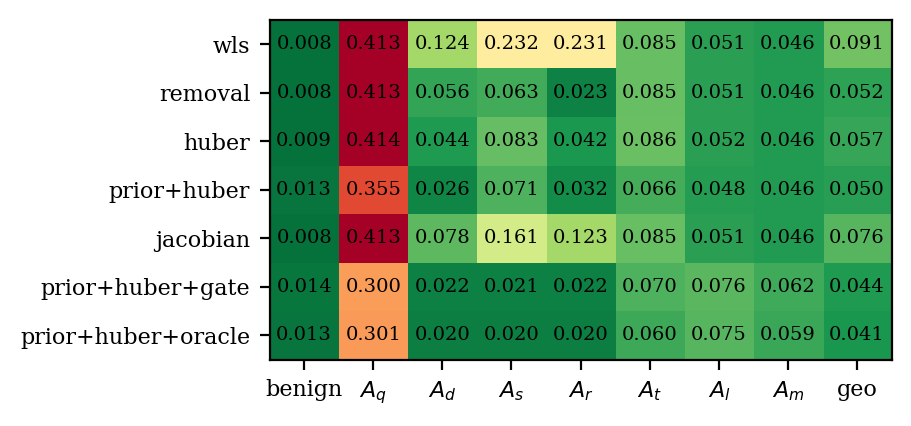 |
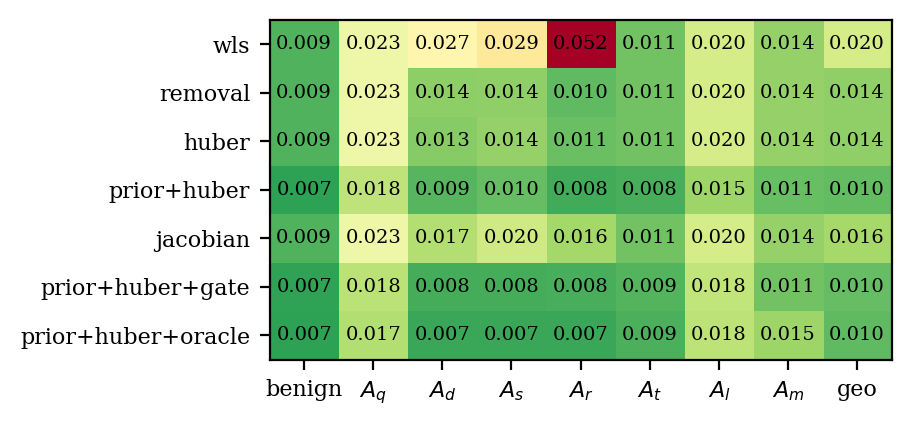 |
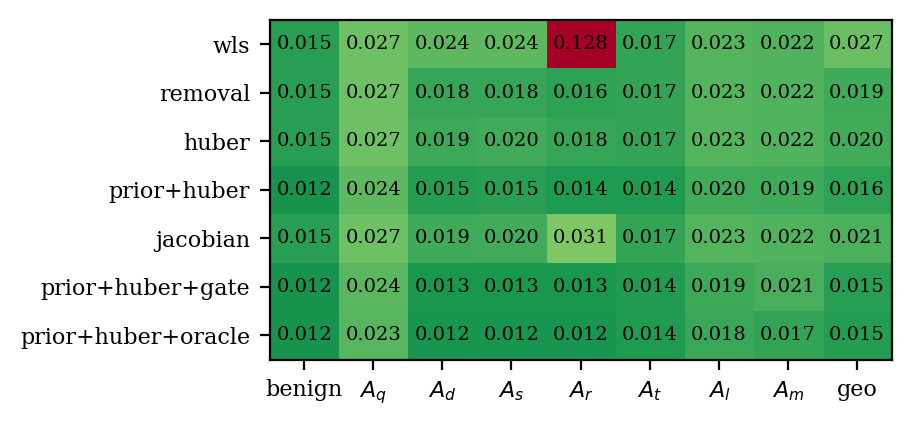 |
| families | what happens | why |
|---|---|---|
Ad As Ar (in place) |
robustness cleans up what it can see: the largest angle reductions of the table, and the voltage error falls on every system | corrupted meters leave large residuals for removal, Huber and the prior to reject |
Aq At Al Am (stealthy) |
move part of the way, through the prior alone | the local false state is a consistent AC state, so no residual exists and Huber sees nothing; it also sits off the benign operating subspace, so the prior pulls the estimate back part of the way; the rest needs temporal information (../localization/README.md) |
On IEEE-14 the benign angle error rises (0.008 to
0.013 degrees): the rank-0.20 prior is tuned for the attacked records and costs the clean ones a little, while the benign voltage error still falls
58%.
Jacobian-informed weighting
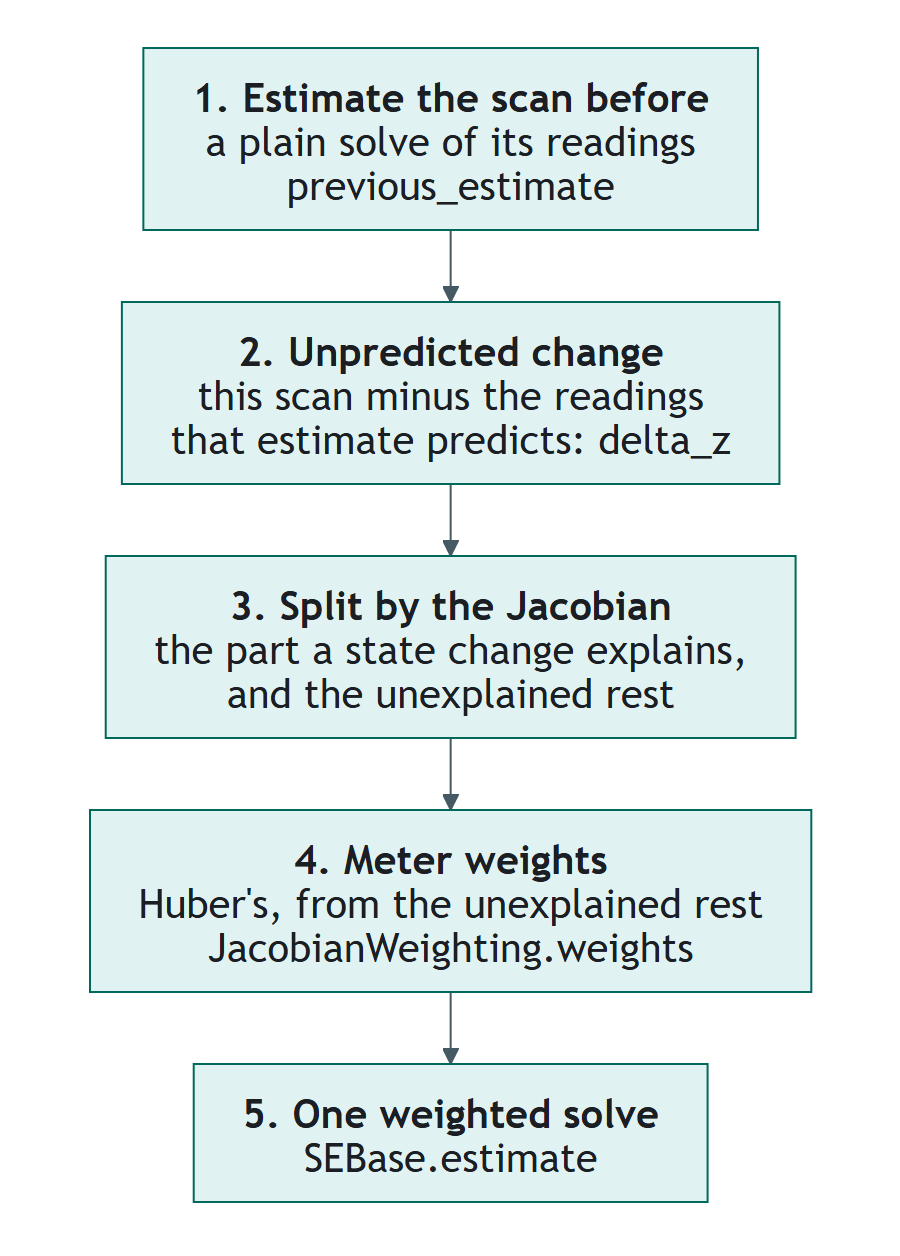
The change is Δz = z_t − h(x̂_{t−1}), this scan against the readings the previous frame's
estimate predicts. The explained part is r∥ = P_H Δz with P_H = H (HᵀWH)⁻¹ HᵀW, and the
unexplained rest is r⊥ = (I − P_H) Δz. The weight of meter i is its fitted weight times
Huber's factor min(1, c / (|r⊥_i| / σ_i)); H and W are the fitted chord Jacobian and meter
weights.
| result | 14 | 118 | 300 |
|---|---|---|---|
| WLS angle error reduction (%) | 17 | 23 | 21 |
Ar, WLS → Jacobian weighting (deg) |
0.231 → 0.123 | 0.0516 → 0.0155 | 0.128 → 0.031 |
Aq, WLS → Jacobian weighting (deg) |
0.413 → 0.413 | 0.0235 → 0.0235 | 0.0274 → 0.0274 |
| against iterated Huber (deg, geometric mean) | 0.076 vs 0.057 | 0.0156 vs 0.0139 | 0.0213 vs 0.0198 |
The gain comes from the in-place families; the stealthy families are untouched, as (I − P_H)a = 0
predicts. The temporal unexplained residual carries what Huber already recovers from the estimate's
own residual, so this route cannot move the proposed estimator. The routes that can are a localizer
gate and, ahead of it, a trusted set of meters.
Localization-gated estimation
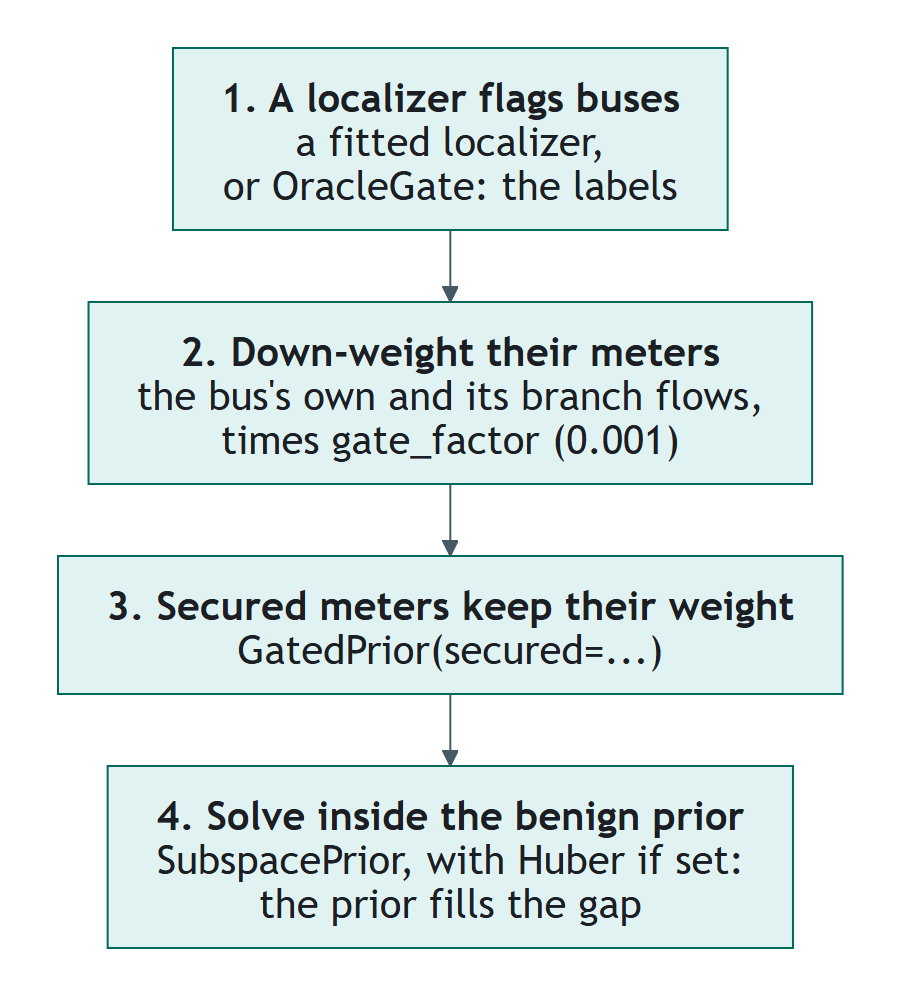
Angle mean absolute error in degrees, the proposed estimator alone, with the CNN localizer as the gate, and with the true labels as the gate (the ceiling for any gate):
| angle MAE (deg) | proposed 14 | + CNN gate 14 | + oracle 14 | proposed 118 | + CNN gate 118 | + oracle 118 | proposed 300 | + CNN gate 300 | + oracle 300 |
|---|---|---|---|---|---|---|---|---|---|
| Aq stealthy re-solve | 0.355 | 0.300 | 0.301 | 0.0181 | 0.0176 | 0.0168 | 0.0241 | 0.0239 | 0.0234 |
| Ad / As / Ar in place | 0.026 / 0.071 / 0.032 | 0.022 / 0.021 / 0.022 | 0.020 / 0.020 / 0.020 | 0.0094 / 0.0103 / 0.0080 | 0.0082 / 0.0082 / 0.0083 | 0.0074 / 0.0075 / 0.0073 | 0.0146 / 0.0154 / 0.0140 | 0.0128 / 0.0128 / 0.0129 | 0.0122 / 0.0122 / 0.0122 |
| At slow ramp | 0.066 | 0.070 | 0.060 | 0.0084 | 0.0092 | 0.0085 | 0.0136 | 0.0144 | 0.0137 |
| Al redistribution | 0.048 | 0.076 | 0.075 | 0.0147 | 0.0182 | 0.0178 | 0.0196 | 0.0187 | 0.0185 |
| Am multi-snapshot | 0.046 | 0.062 | 0.059 | 0.0106 | 0.0115 | 0.0148 | 0.0194 | 0.0205 | 0.0175 |
| geometric mean | 0.050 | 0.044 | 0.041 | 0.0102 | 0.0103 | 0.0100 | 0.0161 | 0.0155 | 0.0147 |
| families | what the gate does | why |
|---|---|---|
Ad As Ar (in place) |
finishes the job at every size, the CNN gate close to the oracle's | the flagged bus's meters are the corrupted ones, the prior fills a hole that held nothing true |
Aq At Al Am (stealthy) |
makes Al and Am worse on 14 and 118, with the true labels too; mixed on 300; it improves Aq on 14 |
a local false state is a consistent AC state, so the flagged bus's meters are the evidence the prior was using; pulled out, the prior guesses from the neighbours, which describe the false state |
The CNN gate changes the geometric mean by 12% on IEEE-14,
-1% on 118 and 4% on 300 (a reduction when positive): the in-place
families (and Aq on 14) gain, and the stealthy-family losses (Al and Am most) offset that gain
on 118. The gate pays most when it has something true to leave in: with 20 meters secured by the
DQN selector of ../trust/README.md and exempt from the gate, IEEE-14 goes
from 0.050 degrees to 0.031 with the secured meters alone and to
0.017 with the same CNN gate added. Recovering a stealthy false state from one scan otherwise needs the previous scan, the temporal direction.
Regenerate
The scripts that ran the study are not part of this repository; the runs they wrote are in the results store (se.estimators).
python tools/results_docs.py --write fills this page's results blocks from the store.