Contributing
Other groups load these packages in their experiments, so the rules keep their numbers stable. Every rule is a command you can run.
The repository holds two toolkits, and every rule below covers both. The generation toolkit is the
distribution fdia-graph, the package fdia_graph under src/, with its tests in tests/: it
generates a timeline and loads it. The analysis toolkit is the distribution fdia-analysis, the
package fdia_analysis under analysis/src/, with its tests in analysis/tests/ and its own
analysis/pyproject.toml: state estimation, localization, federated training, trusted-meter selection
and the results store's code. The dependency points one way: fdia_analysis imports fdia_graph,
and nothing in fdia_graph imports fdia_analysis (tests/test_toolkit_boundary.py). A model or a
formula the generator or the loader uses lives in fdia_graph (models/, formulas/); one only
the analysis packages use lives in fdia_analysis; no name is exported by both.
Setup
git clone https://github.com/myersben9/fdia-graph
cd fdia-graph
pip install -e ".[generate,torch,dev]" -e "./analysis[se,federated]"   # both toolkits, from this checkout
pytest -n auto                                # both suites (tests, analysis/tests) in parallel (pytest-xdist,
                                              # in the dev and test extras); each worker builds its own tiny
                                              # timeline and pool download. Always from the repository root:
                                              # its conftest.py holds the fixtures of both suites
docs/concepts/flow.md is the map and the reading order; docs/reference/MODULES.md says what every
file does.
Every diagram is a rendered image, never a Mermaid block: the README is also the PyPI page, and the
docs are read in the GitHub mobile app, and neither renders Mermaid. Each diagram's source is a
docs/figures/diagrams/<name>.mmd next to its <name>.png and <name>.svg; edit the source and
re-render with python tools/render_mermaid.py docs/figures/diagrams/<name>.mmd (Playwright with
Chromium), which writes both images, then commit all three. A hand-written flow diagram is drawn for
a phone: the renderer uses 20 px type and the site's teal palette, and puts the diagram at its natural
size on a white card 450 px wide with rounded corners, so the PNG (two device pixels per CSS pixel) is
900 px wide and reads on a dark page and on a light one. python tools/prereview.py fails a
hand-written flow diagram that is not flowchart TB, has more than 8 nodes or has a PNG wider than
900 px, or names a node otherwise than name["label"]; the diagrams not yet redrawn are listed in
NOT_YET_REDRAWN in tools/prereview.py. On the docs site docs/stylesheets/extra.css shows a phone
diagram at most 450 px wide, and names the same exempt diagrams. The class
and module diagrams of docs/reference/CLASS_MAP.md are generated: python tools/class_diagrams.py
rewrites their sources from the code (CI fails when they are stale), then render them the same way;
the renderer knows them by name (classes_*, modules), keeps them wide (Mermaid's default theme on
a 1400 px page) and the gate exempts them. README images use the
raw.githubusercontent.com URL so PyPI shows them; docs pages use relative paths.
The Models section of docs/reference/DATA_DICTIONARY.md is generated too: python tools/models_doc.py
rewrites it from the dataclasses in the two models/ packages (src/fdia_graph/models/,
analysis/src/fdia_analysis/models/) and the comment beside each field. Edit
the comment in the source, never the section, and rerun the tool; the tests fail when it is stale.
The docs site is built from docs/ plus the three root pages by mkdocs.yml: the Vercel build serves
the main branch at the custom domain, and .github/workflows/docs.yml deploys one copy per package
version to GitHub Pages with mike (a tag push deploys that version as latest, a push to main
deploys dev), so every release's docs stay readable after the next release; the version picker on
each page switches between them. python tools/site_index.py && python -m mkdocs build --strict
checks a docs change locally.
The pages are sorted by kind, one folder each (DOCS in tools/layout.py): tutorials in
docs/getting-started/, tasks in docs/guides/, explanations in docs/concepts/, studies in
docs/analysis/ and facts to look up in docs/reference/. python tools/prereview.py fails a page
under docs/, or the README, that holds a fenced Mermaid block or an internal decision code (a
capital N or D followed by one to three digits, as a word of its own); the pages not yet cleaned are
listed in NOT_YET_PLAIN in tools/prereview.py, each with its reason. CHANGELOG.md is not read.
The rules
| rule | means | command |
|---|---|---|
| nothing a user sees changes without a changelog entry | public API, file formats, the numbers a timeline, estimator or localizer produces; a private name (a leading underscore) carries no promise and gets no alias when it moves | CHANGELOG.md, ## Unreleased |
| every change is proven behaviour-free, or its effect is measured | the tests pin the fewest-tamper search's answers (tests/test_search_speed.py), [WU26]'s scenarios (tests/test_overload_case_studies.py), the formulas and models, and whole generated files: every dataset and attribute of an IEEE timeline against stored digests (tests/test_timeline_digests.py; bit for bit on the machine that recorded them, skipped elsewhere, tests/digests.py); a change that moves a generated number states the delta and rewrites the snapshot with FDIA_UPDATE_DIGESTS=1 |
pytest -W "error::DeprecationWarning:fdia_graph" tests |
| code reads as its subject | complexity 10, nesting 3, no closure captures, at most 7 parameters, no positional record indexing; every equation a named function in formulas/ with a source key; every returned bundle a model in models/ |
python tools/readability.py --report, --check --base origin/main |
| an input is checked in one place | a new argument is a field on its consumer's model in models/config.py, with its rules in the annotation (Annotated[float, Positive()], OneOf(<Choice>)) and cross-field rules in invariants(); a dataset precondition is a ds.require(...) capability; a condition only the data reveals raises a named error from errors.py; never a raise ValueError in a function body |
python tools/readability.py --check (refuses a new one) |
| everything is typed | every parameter, return and field carries its real type; an optional dependency's type (pandapower, torch, h5py, scipy, pandas) is imported under if TYPE_CHECKING: so the import stays lazy; Any only where the value can be anything, listed in ANY_ALLOWED in tools/readability.py with the reason |
python tools/readability.py --check (refuses an unlisted Any and a stale entry), pyright in CI |
| typed, formatted, linted | pyright at zero, ruff format and check clean | pyright src/fdia_graph analysis/src/fdia_analysis, ruff format --check src/fdia_graph analysis/src/fdia_analysis conftest.py tests analysis/tests tools pipelines, ruff check src analysis/src conftest.py tests analysis/tests tools pipelines |
| generated docs match the code | the class and module diagram sources and the data dictionary's Models section | python tools/class_diagrams.py --check, python tools/models_doc.py --check |
| no measured number is typed into markdown | a harness writes what it measures through fdia_analysis.results.run.Run into the results store (results/, see its README); a doc shows a number or a table through a results block (<!-- results: <query> ... -->, queries in results/queries.py), a CHANGELOG entry names the experiment; settings and published values from papers stay as text |
python tools/results_docs.py --write, --check; --lint lists typed decimals |
| a file's name says what it does | plain words: never its folder's name again (tests/nygrid/test_grid.py, not test_nygrid_grid.py), never a sibling's name plus a short ending (reduce.py beside reduced.py), no digit, no citation key or first author's surname from REFERENCES.md |
python tools/layout.py --check |
| every file says what it does, and every page keeps up | every Python file opens with a docstring whose first paragraph is its line in docs/reference/MODULES.md; every package has a page (PAGES in tools/layout.py) that names each of its modules; every module or name a doc or docstring cites in a code span exists; every folder at the root and under docs/ has its role in the tool's repository map |
python tools/layout.py writes the file map; --check in the pre-review and CI |
| a constant has one home | a value nothing in a run changes (a physical or regulatory fact, a column position, a code, a pinned input, a fitted number) is defined once in the generation toolkit's constants/ package, with its unit and source, or in schema.py when it is part of the file protocol; a value a user tunes is a field of a settings model in models/config.py; a module-level UPPER_CASE name anywhere else in fdia_graph is listed in EXEMPT in tools/layout.py with its reason, and fdia_analysis may add none to the ones EXEMPT_ANALYSIS lists |
python tools/layout.py --check |
| speed is tracked | per-record timings against the last row from this machine, 3x tolerance | python tools/bench.py --check before a release, python tools/bench.py after |
Docstrings are short, and say what the signature does not:
- a module docstring is at most about 10 lines: what the module is for and where it fits, no history;
- a class docstring is at most about 6 lines: what the class represents (a class whose docstring is the
table of its attributes, as
FdiaGenerator's, may be longer); - a function or method docstring is 1 to 3 lines (a few more when an equation or an argument table needs them): what it returns or does, the units, the equation with its source key, and the one thing a caller would not guess.
The pull request
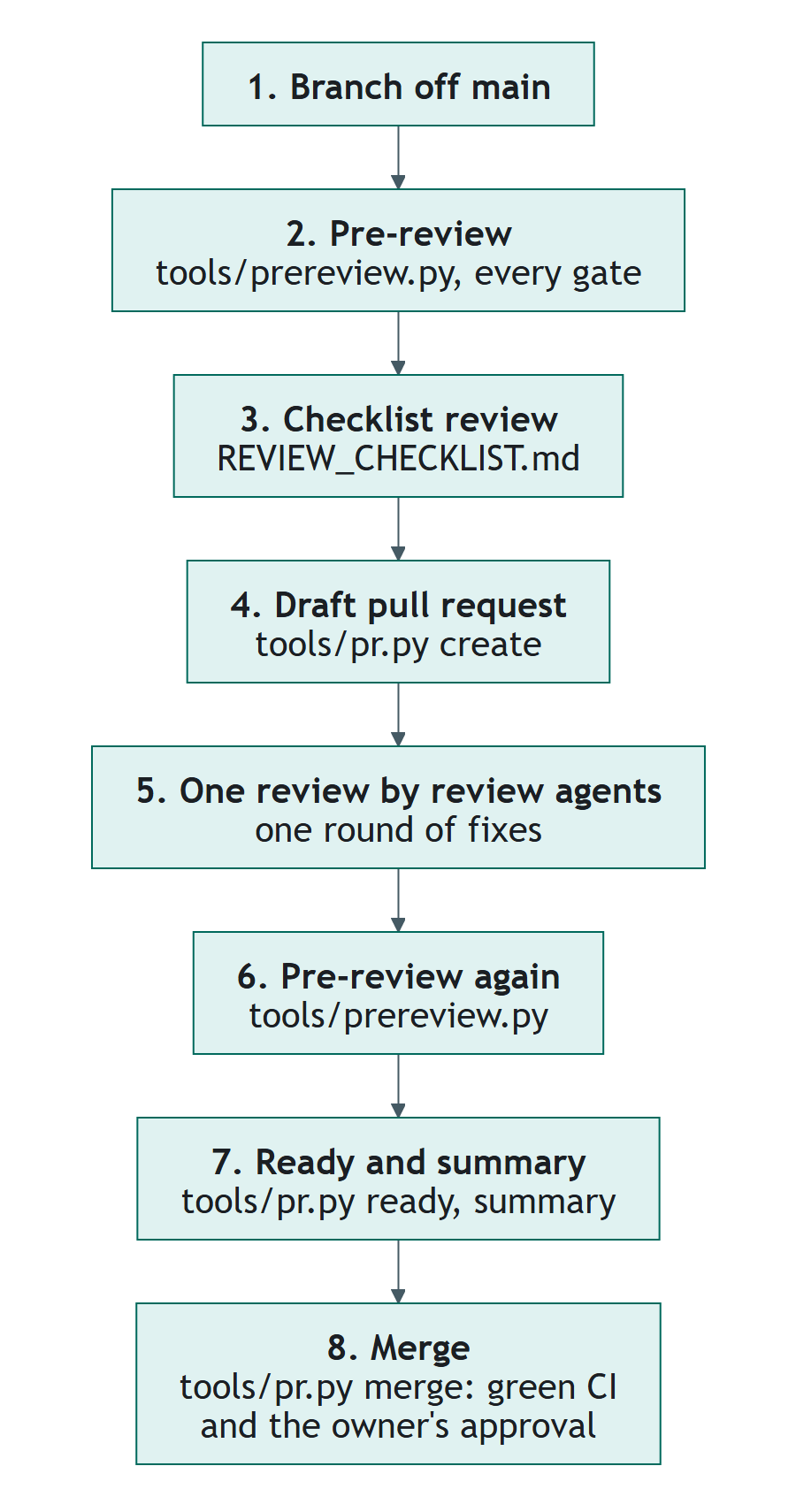
python tools/prereview.py                                      # every gate, locally, on this checkout's source
python tools/prereview.py --also-python <path-to-python3.12>  # and the suite on a second Python, as CI runs 3.9 and 3.12
python tools/pr.py create my-branch "One-line title" body.md   # a draft; body: what, why, what you checked
python tools/pr.py ready 80                                    # once clean: ready for the owner
python tools/pr.py wait 80                                     # until CI has finished
python tools/pr.py comments 80
python tools/pr.py reply 80 <comment-id> "what changed"
python tools/pr.py summary 80 summary.md                       # the four-sentence summary for the owner
python tools/pr.py merge 80                                    # refuses unless green
Green means: every job of the smoke workflow (tests, tests (3.9), tests (windows), typecheck,
format, readability, the two installs) is a completed success on the head (a job that has not
started yet counts as not green) and every other listed check has finished without failure.
A pull request merges when it is green and the owner approves it. The repository runs no automated
review. A pull request is opened as a draft while it is worked on and
marked ready once it is clean. Related work goes in one pull request per theme rather than one per
step, and an open pull request is rebased only for a real conflict. The order:
python tools/prereview.pyuntil it passes: the CI gates, the test suite, and the checks CI does not run (changelog, cited paths, vacuous tests, integer fields, rendered diagrams).- The review checklist,
docs/reference/REVIEW_CHECKLIST.md, against the diff and every touched file read whole, searching outward from every change (a/code-reviewin Claude Code with the checklist does this). Fold what it finds into the branch. - Before the pull request leaves draft, one review of the diff by Claude Code review agents (no paid review service);
its findings are fixed in one round, not looped, and its four-sentence summary of the change is posted on
the pull request (
tools/pr.py summary) for the owner. - Mark the draft ready and merge it on green once the owner approves.
tools/pr.py uses the token the Git Credential Manager holds for git push, so it
needs no gh CLI. Commit as yourself, with a message that says what the change does. If CI does not
start on a push, check the account's Actions minutes first.
Releasing
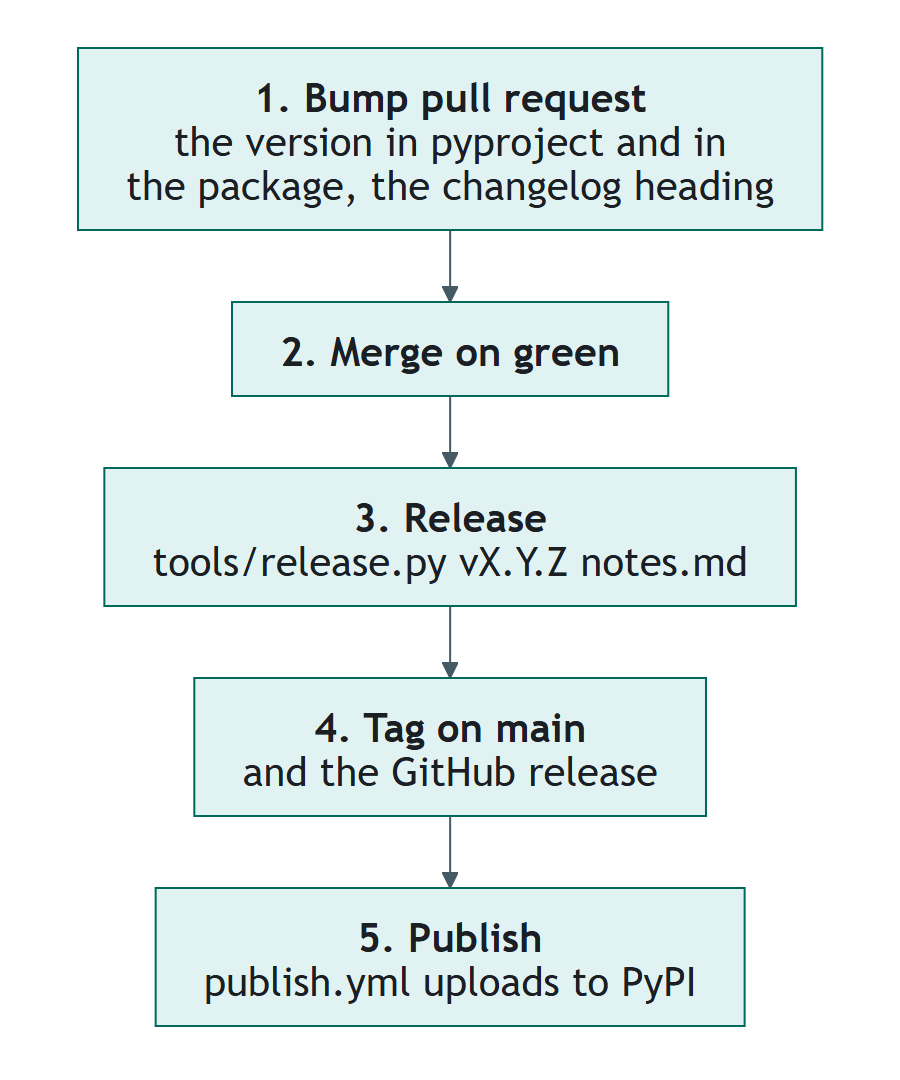
The two toolkits are released together at one version: the root pyproject.toml,
fdia_graph.__version__, analysis/pyproject.toml and fdia_analysis.__version__ say the same
number, and fdia-analysis requires exactly fdia-graph==<version> (tests/test_versions.py;
tools/release.py refuses a tag where it does not hold). The bump PR changes all five lines, and a tag
vX.Y.Z publishes both distributions (publish.yml).
Before the first tag that publishes fdia-analysis, the project needs a pending trusted publisher on
PyPI (pypi.org, Your account, Publishing: owner myersben9, repository fdia-graph, workflow
publish.yml); without it the upload of fdia-analysis is refused after fdia-graph is already out.
A publish run that failed part-way can be run again: each upload skips the files PyPI already has.
After the release that ships the new README.md, delete docs/figures/diagrams/pipeline.mmd, its
.png and its .svg, and take pipeline off NOT_YET_REDRAWN in tools/prereview.py and off
docs/stylesheets/extra.css: until then the published PyPI page loads that PNG from main.
A released version is never re-cut; fix forward. Data releases (timelines, pools) have their own
tags, data-v<x.y.z> (the bare v0.x.y tags belong to package versions), and do not move the
package version. The
registry maps the short name (fg.load(..., release="v0.8.0")) to the tag, and
tools/upload_assets.py v0.8.0 <files> refuses to touch a package tag.
The files of a data release are one pool_ieee{N}.h5 and one timeline_ieee{N}.h5 per system. python tools/upload_assets.py vX.Y.Z notes.md <files> creates the
data-vX.Y.Z release and uploads them; it never replaces an asset already on the release. The sha256 of
each file then goes in SHA256 in src/fdia_graph/constants/releases.py, and PINNED_RELEASE in the same
module is moved last.
Test and release commands
| command | what it runs |
|---|---|
python tools/prereview.py |
every CI gate, the test suites and the checks CI does not run, on this checkout's source |
pytest |
both suites from the repository root, on this checkout's source; builds a tiny IEEE-14 timeline in a throwaway cache (about a minute) |
pytest tests |
the generation toolkit's suite, which runs with fdia_analysis blocked (tests/test_toolkit_boundary.py) |
pytest analysis/tests |
the analysis toolkit's suite, on the same tiny timeline (the root conftest.py) |
FDIA_SLOW=1 pytest |
adds the slow checks: the estimator test on the published IEEE-118 file and the longer attack searches |
CI (.github/workflows/smoke.yml) |
the tests on Linux (3.12 and 3.9) and Windows, pyright, ruff format and check, the readability gate, the layout gate, the generated-docs checks, the install on 3.9 and 3.12 |
python tools/release.py vX.Y.Z notes.md |
after the bump PR: the tag, the GitHub release and the upload to PyPI |
The New York tests and snapshots
tests/nygrid holds the tests of the New York case. They need the [ny] extra and read their inputs
under NYGRID_ROOT, the work folder of docs/guides/operating_points.md (its data/ and out/). A
test whose input is missing is skipped. tests/nygrid/inputs.py says which input each test needs.
| input | where | which tests |
|---|---|---|
| the public inputs | NYGRID_ROOT/data, downloaded by fetch_inputs |
most tests; CI runs the folder on these (.github/workflows/nygrid.yml) |
| the pool's frames of two days | checked in, tests/nygrid/data/days |
the timeline and client tests on the New York case |
The golden snapshot pins what the persistence rule returns on fixed inputs.
| snapshot | compared by | rewritten with |
|---|---|---|
analysis/tests/golden/persistence_rule.json, two numbers |
analysis/tests/test_detect.py; needs no data |
an edit to the file |
tests/nygrid/test_examples.py runs the attack-family example of docs/guides/extending.md as
published, and analysis/tests/test_detect.py the alarm-rule example. A change to the case file
src/fdia_graph/systems/case_nygrid.m moves generated numbers, so it comes with the snapshots it moves.
Where things live
The first four rows are the generation toolkit (src/fdia_graph/), the next four the analysis toolkit
(analysis/src/fdia_analysis/); a record or a formula is in the models/ or formulas/ of the toolkit
that uses it.
| you want to change | look in |
|---|---|
| an attack family, the plausibility band, the meter model | engine/, formulas/attacks.py, formulas/noise.py |
| what a timeline file contains | generation/ by stage: plan.py (splits and placement), design.py (the overload Am, in parallel), emit.py (the frames), write.py (the file); generation/__init__.py (the pool and generate); source.py holds the one path of every timeline (TimelineSource.generate) and the grids are its subclasses (ieee.py an IEEE case, newyork.py the New York grid); timeline.py is the IEEE entry point; then docs/reference/DATA_DICTIONARY.md |
| a generation setting | its model in models/config.py (TimelineSettings and the nested RampSettings, SearchSettings, OverloadSettings, MeterSettings, SplitSettings); generate_timeline takes every field as a flat keyword too |
| how a timeline is loaded or exported | dataset/, one concern per file |
| an estimator | se/methods.py, its algebra in formulas/estimation.py |
| a localizer | localization/methods.py or learned.py |
| the trusted-meter selectors | trust/, its algebra in fdia_analysis/formulas/trust.py (the row reduction it builds on, which the attack search also uses, in fdia_graph/formulas/trust.py) |
| the federated localizers and prior | federated/, its algebra in formulas/federated.py |
| a returned record's fields | models/ |
| a formula | formulas/, and its row in docs/reference/FORMULAS.md |
| any file, to learn what it does | docs/reference/MODULES.md, the first paragraph of every file's docstring |
| a study's numbers or figures | its runs in the results store (results/), its page under docs/analysis/ |
| how released New York data is built | pipelines/newyork/ |
| a new folder | its role in REPO or DOCS in tools/layout.py first; the gate fails a folder without one |