Class map
How the pieces of the two toolkits connect, the generation toolkit fdia_graph and the analysis
toolkit fdia_analysis: one module diagram of both and eight class diagrams, all drawn from
the source by tools/class_diagrams.py (the AST gives each class's public methods, its bases and the
classes of other modules it names), so they cannot drift from the code. CI checks that the committed
sources match; python tools/class_diagrams.py rewrites them and tools/render_mermaid.py renders.
Read with MODULES.md (what each file is for) and
CONCEPTS_TO_CODE.md (which function implements which idea).
An open arrowhead is inheritance, a dashed arrow is a class using another (an argument type, a return type or a collaborator it builds), and a box marked with another package's name is a participant that lives there.
The diagrams are wide and are best viewed on a wide screen. Each picture links to its full-size file.
Modules
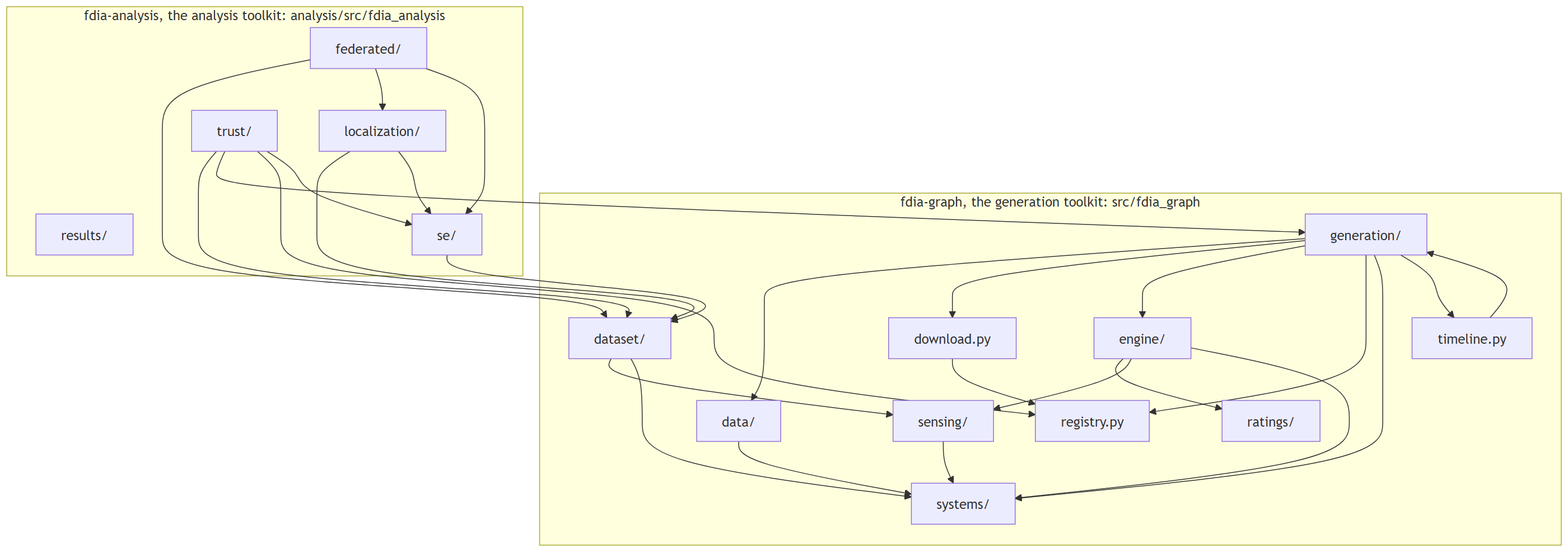
Which module imports which, in one picture with a box per toolkit: every arrow between the boxes
runs from the analysis toolkit to the generation toolkit, never back. Five foundations are read by
nearly every module and are left out so the real dependencies show: each toolkit's models/ (the
returned records and the settings; the one validation engine is fdia_graph.models.validation) and
formulas/ (the equations), and the generation toolkit's constants/ (the facts, each with its unit
and source), schema.py (the file protocol) and errors.py (the named errors). Each package's own __init__.py (for fdia_graph, the fg.*
public API, which imports everything) is left out for the same reason.
The dataset
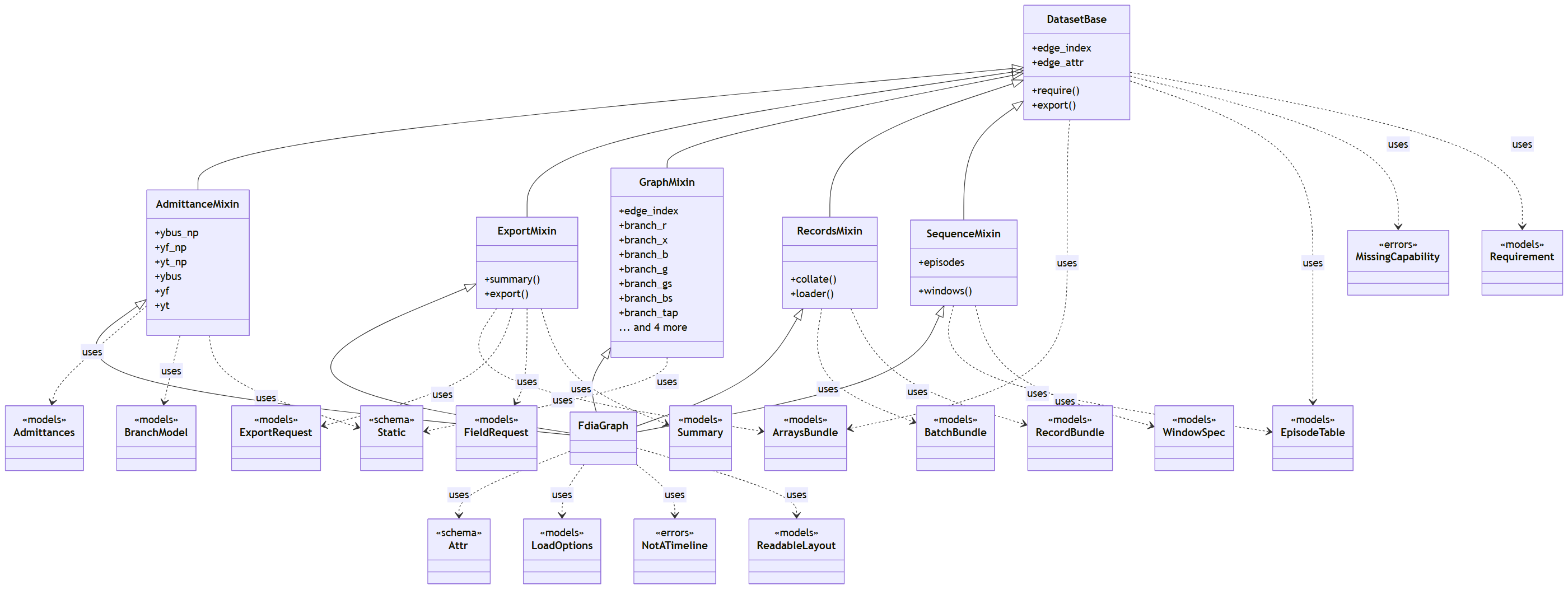
FdiaGraph is the file. Five mixins over DatasetBase give it its faces: the static graph physics
(GraphMixin), the admittance matrices (AdmittanceMixin), records and batches (RecordsMixin), the
exports (ExportMixin) and the time-ordered windows and episodes (SequenceMixin). The methods that
produce records return models bundles (a record, a batch, an exported split, the episode table, the
summary); the graph properties are tensors or arrays, loader() is a DataLoader and windows() a tuple.
The engine
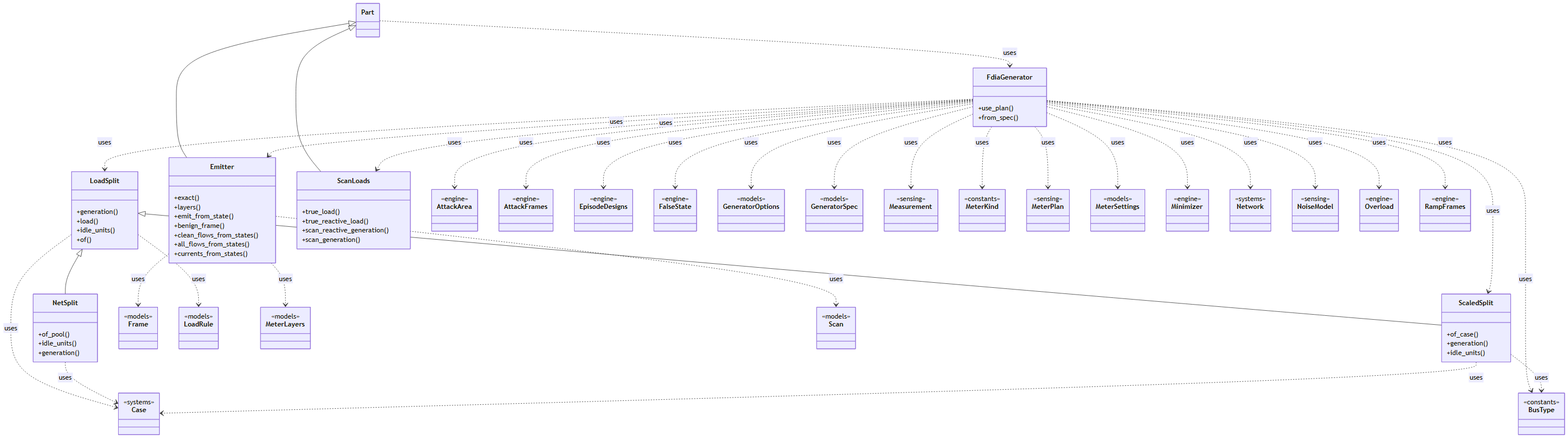
FdiaGenerator is the AC model of one test system with its meter plan: the Network of its Case (an IEEE
case's is Network.from_ieee), a MeterPlan
(MeterPlan.from_coverage, or a plan given), a Measurement and a NoiseModel. It also holds one
object of each of its parts (engine/base.py, Part): a part does one job and holds the generator, so
it reads the grid as self.g.case and calls another part as self.g.area.hop_area(...). ScanLoads
(g.scan_loads) reads a scan's load and generation and Emitter (g.emitter) emits scans; the parts of
engine/attacks/ build every attack (next section). Emitter.benign_frame emits a benign scan, and a
designed episode (engine/attacks/family.py, DesignedEpisode) asks the parts for each attacked one;
timeline.py decides when and where each episode runs.
The attacks
Every attack is built in engine/attacks/, one part of the generator per module:
AttackArea (g.area) finds the attacker's area, FalseState (g.false_state) solves and checks its false state, AttackFrames
(g.attack_frames) writes the attack vector onto the true scan, RampFrames (g.ramp_frames) builds the ramp frames, Minimizer (g.minimizer) finds the support that tampers
the fewest devices over an attack window [WU26, eq. 12] (AttackWindow, window.py, counts what a
support costs), Overload (g.overload) builds the overload Am,
and EpisodeDesigns (g.episode_designs) designs what an At or an Am episode attacks. RampFrames.ramp_frame
is the one entry for an attacked At scan; an Am frame comes from overload_step. The walk reaches
both through a designed episode (engine/attacks/search.py: RampEpisode, OverloadEpisode).

State estimation
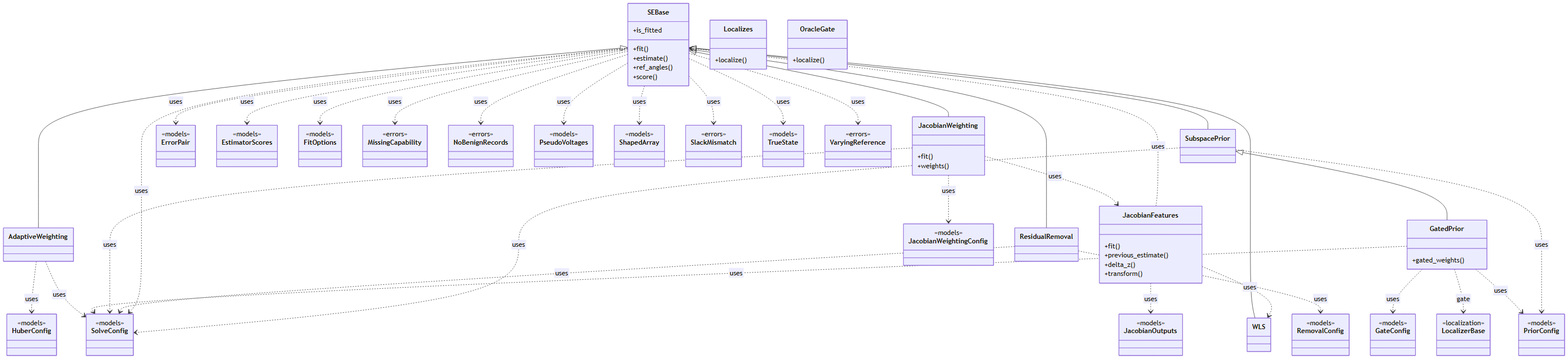
SEBase holds the shared solve: the measurement function, the chord Jacobian, the meter weights and the
chord-Newton loop. Each estimator overrides one hook. GatedPrior takes a fitted localizer as its gate;
JacobianFeatures is the per-bus feature block the localizers can consume.
Localization and trusted meters
LocalizerBase calibrates any per-bus score to one false-alarm budget; the threshold arms score a stored
feature, ResidualLocalizer runs an estimator, the learned arms train a per-bus network.
TrustSelector chooses the meters to secure on the WLS Jacobian, by row reduction (TrustedMeters) or
by a deep Q-network (TrustedMetersDQN), and scores the residual test with them secured.

Federated training
FederatedLocalizer is a LearnedLocalizer whose fit runs FedAvg over a Partition of the buses:
each client trains its own copy with the shared LocalTrainer on its own buses, and FedBusMLP and
FedBusCNN take their encoder from BusMLP and BusCNN. RoundLog records every round.
RegionalPrior is a SubspacePrior whose basis is fitted per client of a Partition.

The records
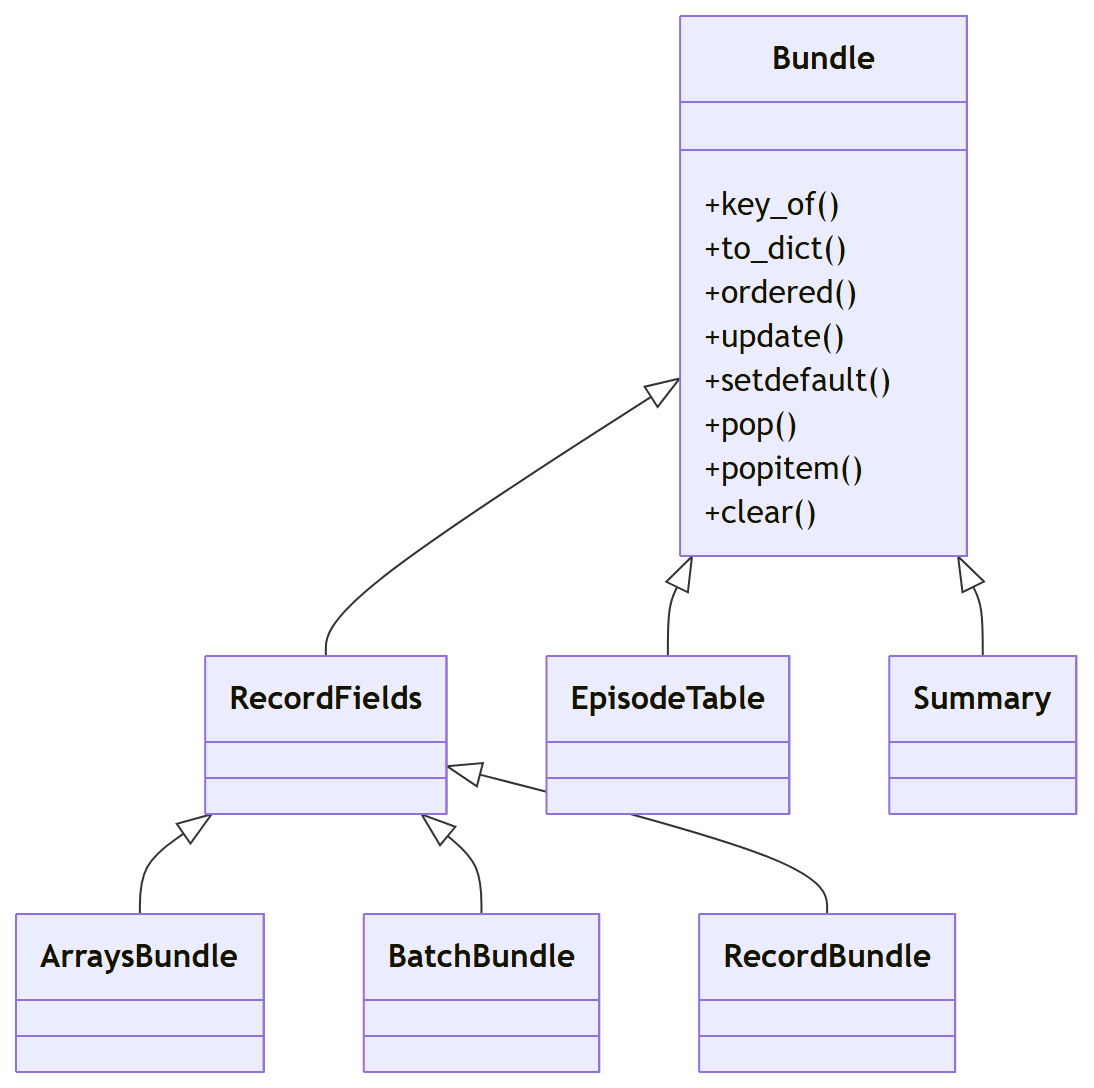
Everything a call returns is a Bundle, a dict with attribute access and a fixed key order. The record
forms share one base, RecordFields, which declares every field once, so a record, a batch and an exported split
carry the same names. An exported split adds the export-only prev_* fields
(the previous frame's readings on a timeline).
The scores
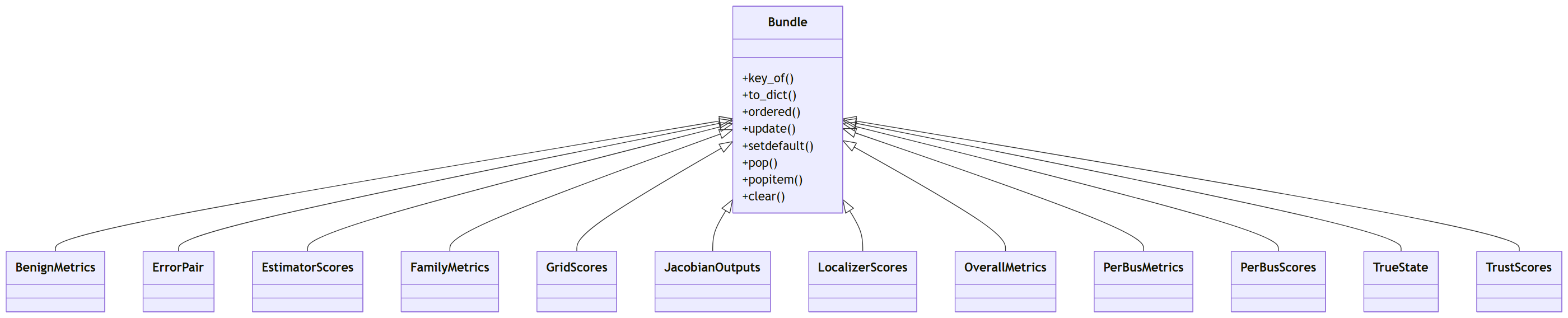
The result of every score() is a Bundle too, defined in the analysis toolkit
(fdia_analysis.models.scores) on the generation toolkit's Bundle: ErrorPair and EstimatorScores for the estimators,
OverallMetrics, BenignMetrics, FamilyMetrics and LocalizerScores for the localizers, TrustScores
for the trusted meters, JacobianOutputs for the feature block; TrueState (fdia_analysis.models.data)
is the truth an estimator is scored against.
The named tuples of models/frames.py (Scan, Frame, OperatingLimits, FrameKnobs),
models/grid.py (BranchModel, Admittances) and models/assets.py (AssetSpec) are plain
value types with no hierarchy, so they appear only where a class above uses them.